The Shift in Startup Banking
For international startups in 2026, a bank account is no longer just a place to store capital—it is an operational tool that must integrate with a global tech stack. The traditional banking model, characterized by high wire fees and slow compliance cycles, is increasingly at odds with the speed of global commerce. At Global Operations & Compliance Lab, we’ve analyzed the operational friction between legacy banks and digital-first platforms like Mercury.
1. Fee Structures: The Hidden “Expansion Tax”
Traditional global banks often rely on a complex web of intermediary fees that can act as a hidden tax on early-stage startups.
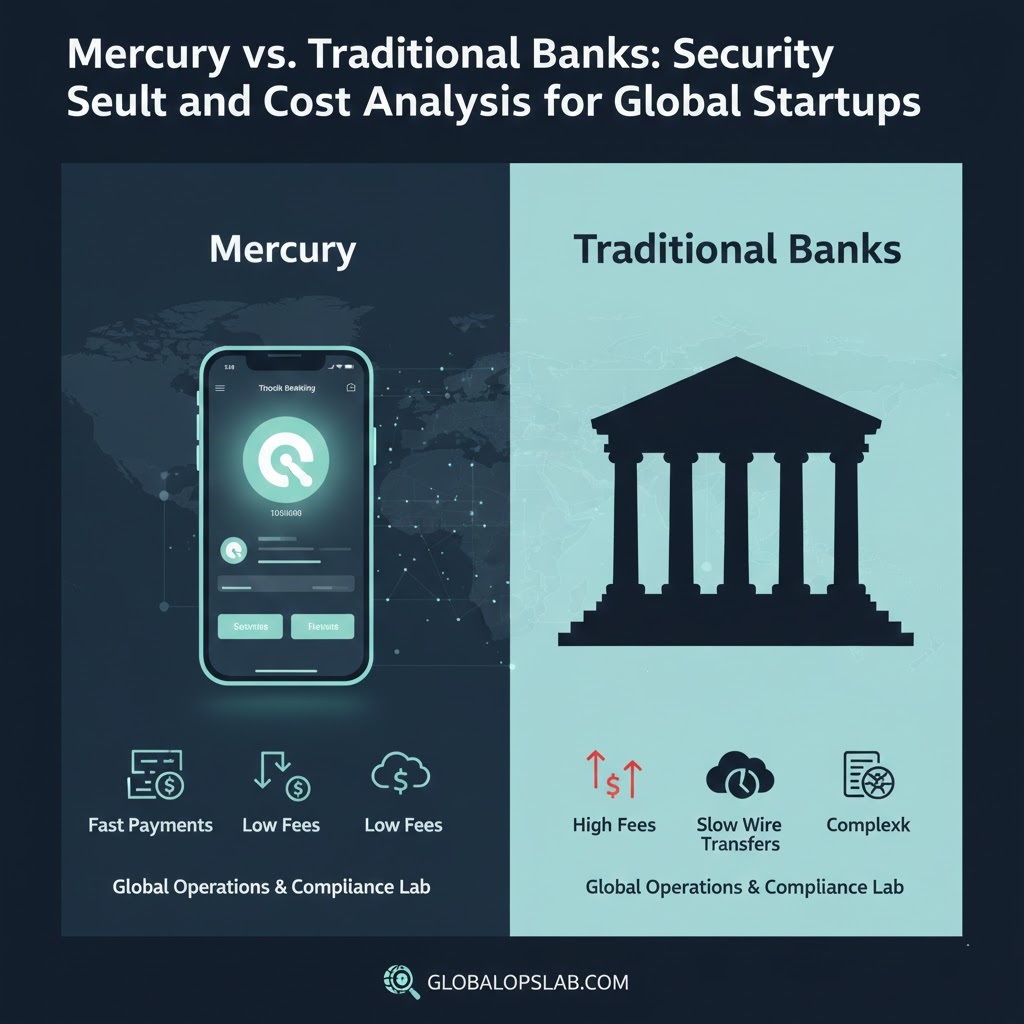
- Traditional Banks: Often charge $30–$50 per outgoing international wire, plus a 1%–3% markup on currency exchange. For a company paying 20 global contractors, these “micro-losses” add up to thousands of dollars annually.
- Mercury: Known for its “no-fee” core banking model (no monthly fees, no minimum balance). Their transparent FX (foreign exchange) rates are significantly more competitive for B2B transactions, making it the preferred choice for seed and Series A startups scaling internationally.
2. Speed and Integration: The Tech Stack Synergy
The modern CFO requires real-time data. Legacy banking portals often feel like relics from the early 2000s, lacking the API capabilities needed for 2026’s automated workflows.
- Digital-First Advantage: Platforms like Mercury offer native integrations with accounting software (Xero/QuickBooks) and compliance tools (Vanta).
- Operational ROI: By automating bank reconciliation, startups can reduce administrative overhead by up to 15 hours per month.
3. Security and Compliance in 2026
A common misconception is that digital platforms are “less secure” than traditional brick-and-mortar institutions.
- FDIC Insurance: Mercury operates as a financial technology company, but funds are held in FDIC-insured partner banks. This provides the same $250,000 protection as a traditional bank, but with a more agile digital interface.
- Fraud Prevention: Modern fintechs leverage AI-driven anomaly detection that is often more responsive than the manual “fraud flags” used by legacy institutions, which often freeze accounts for legitimate international transfers.
4. Global Operations Verdict
For mid-market firms and startups, the decision depends on your geographical footprint:
- Use Mercury if: You are a U.S.-based or international startup requiring a fast, digital-first US dollar account with zero maintenance fees and deep SaaS integrations.
- Use Traditional Banks if: You require complex physical trade finance instruments (like Letters of Credit) or have massive physical retail operations.