The Efficiency Mandate of 2026
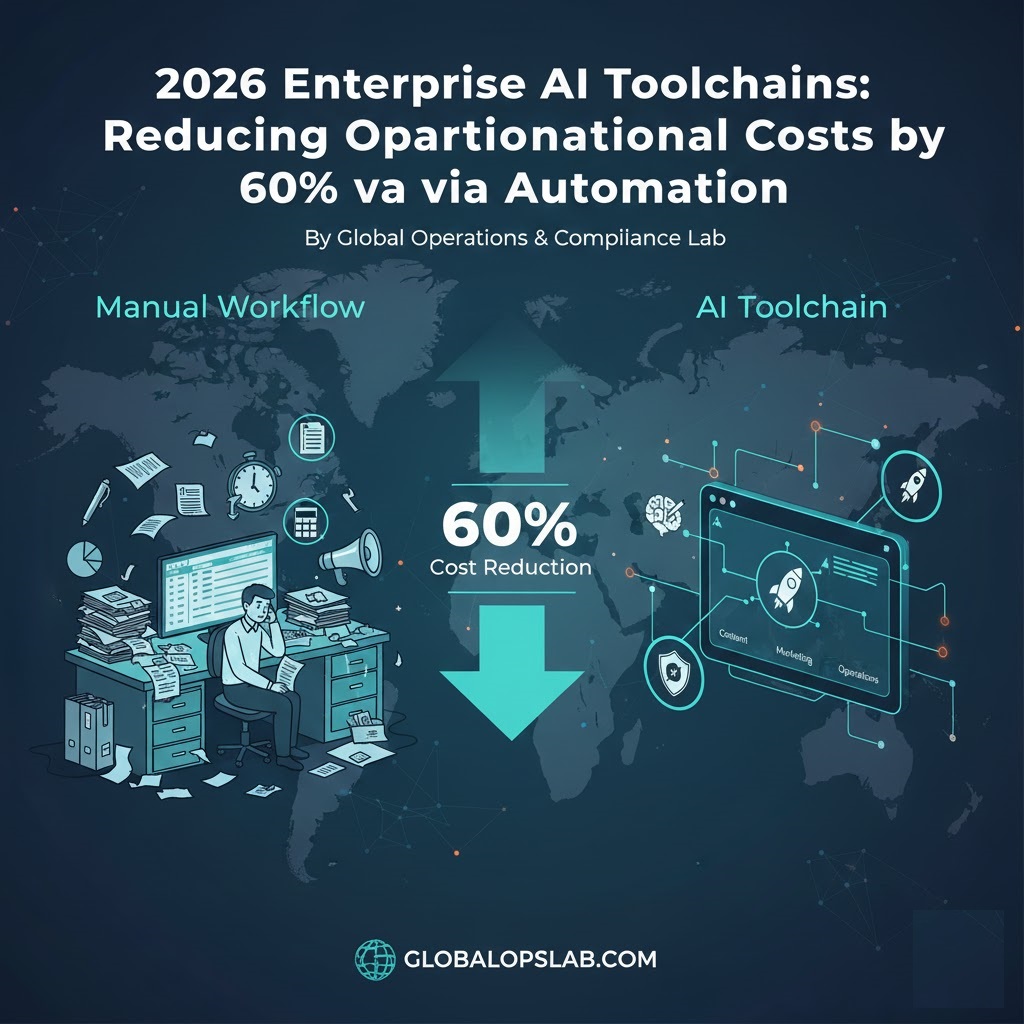
In the current global economic climate, “efficiency” is no longer a buzzword—it is a survival requirement. For scaling enterprises, the cost of human-led content production and manual email marketing has become a bottleneck. At Global Operations & Compliance Lab, our research indicates that companies integrating an “AI Toolchain” can reduce their operational overhead by up to 60% while increasing output volume.
1. The Content Factory: Beyond Simple Text Generation
In 2026, AI content creation has moved past basic chatbots to integrated multi-modal workflows.
- Automated Research & Drafting: Tools that combine real-time market data with LLMs allow teams to produce whitepapers and benchmark reports (like our EOR reports) in hours instead of weeks.
- Visual & Video Consistency: AI-driven design tools now ensure brand-compliant graphics and localized video content can be generated at scale, eliminating the need for expensive external creative agencies.
2. Marketing Automation: Hyper-Personalization at Scale
The most significant “cost-killer” in 2026 is the automation of the B2B sales funnel.
- AI-Powered Outreach: Modern email marketing stacks use AI to analyze prospect behavior and craft individualized messaging, achieving open rates that manual campaigns can no longer match.
- Efficiency Gains: By automating the “top-of-funnel” lead nurturing, marketing departments are reducing the cost-per-acquisition (CPA) by an average of 45%.
3. Case Study: The “Lab” Approach to AI Operations
At our lab, we utilize a proprietary Global Hiring ROI Calculator to measure the impact of AI on workforce productivity.
- The Findings: Companies that replace manual administrative workflows with AI-driven compliance and payroll automation (integrated with platforms like Remote or Deel) see a drastic reduction in “human error costs”.
4. Strategic Recommendations: Building Your AI Stack
To achieve a 60% cost reduction, we recommend a phased integration:
- Audit Your Bottlenecks: Identify repetitive tasks in content creation and lead generation.
- Select Integratable Tools: Choose SaaS platforms that offer robust API support to ensure your AI tools “talk” to your HRIS and CRM.
- Continuous Compliance: Ensure all AI-generated output meets local data privacy standards (GDPR/PIPL) to avoid costly legal friction.
Conclusion
The gap between “AI-native” enterprises and legacy firms is widening. By investing in a structured AI toolchain today, organizations are not just saving costs—they are building the operational agility required for 2026 and beyond.